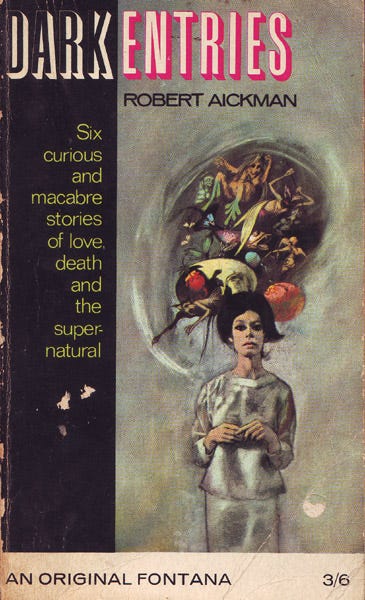
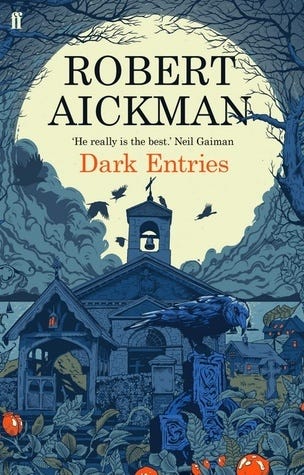
Dark Entries
by Robert Aickman

Such curiously precise sentences, so exact, so perfectly constructed. They tell you everything and nothing. It's the meaning between those words, the implications of what is not being said that disturbs. Those slippery places, those half-conscious spaces. Admire Aickman for his perfect prose and his marvelous subtlety and his dry, dry wit. But love him for what he doesn't tell you, for taking you to a place where your mind must operate on a different level, someplace new and vague and troubling. He paints a picture of the night sky: the clouds and the treetops and the moon, all the stars in all of their strange remoteness. It is up to you to turn them into something, to make of them constellations - and other shapes.
I was surprised and a bit saddened to see two excellent reviews of this book insist that it is not horror. Dark Entries is horror at its most profound. Horror doesn't simply scare; it inspires dread and a certain kind of chilliness, a creeping sort of understanding that the mind often resists. He provides a story that will read like a dream and he provides a meaning that he will only hint at; it is up to the reader to connect the two, to turn the oblique and the opaque into something that has its own logic. Nightmare logic. Aickman is one of the absolute masters of the horror genre.
Dark Entries is Aickman's first solo collection. Perhaps this early in his career he was more invested in creating horrors that were at least somewhat tangible and familiar. Somewhat.
Ringing the Changes has a town that embraces the undead, and a couple that becomes trapped there. It has a suspenseful and eventually hair-raising narrative. But it is not about the undead; it is about the distance between two lovers, the distance that becomes apparent when contrasting the new and the old. A younger woman sees things her way, and rushes forward; she may quail in fear but she will dance with the dead. An older man sees his age, his ineffectuality; he will try to cross a gap and he will fail, impotent.
The Waiting Room has a traveler stranded in a train station, home to ghosts who were buried beneath. It is a ghost story and it is not a ghost story. It is about loneliness, a man as an island, a man alone and unconsciously yearning for a community, for support in his lonely world. He sleeps, and lives a brief dream of a happiness he has never had. He barely recognizes his own desperate need.
Bind Your Hair has a woman engaged to a man, and visiting his perfectly nice relatives in the country. A loving home that feels increasingly like a comfy trap, a soft and pillowy place where she may lose herself. It has a country village where people gather in the evenings, their clean strong limbs bared to the moon... for what purpose? It has two children, a peremptory guide and a savage biter. Our heroine can barely resist them. Bind your hair; bind away all that is you and become one of us.
Choose Your Weapons has a young man fall madly and inexplicably in love with an inexplicable, possibly mad young woman. It has hypnotism and a doctor who may know all. It has a crumbling house and a woman with two faces and a servant who grows younger. It has empty spaces at the heart of it, the gap between love and the reality of living, the excruciating smallness of minds that are obsessed by small things - things like money, class, a name, an appearance, poverty, wealth. Can love ever be stronger than such small things when one part of the pair values the latter over the former? Choose Your Weapons has one of the most nightmarish narratives I've seen in an Aickman story, as well as one of his most startlingly, beautifully abrupt endings.
The School Friend has a writer returning to her hometown and finding her friend much changed, living in a perhaps haunted house that is notable for its drabness, its dusty blandness. A school friend, once uniquely intelligent and idiosyncratic, turning drab, prosaic, dusty, and bland. The heroine slowly explores the house and the discomfort slowly increases. The horror seeps in from the frame until the whole picture is submerged. What's it all about? The meaning is hidden between the sentences, implicit never explicit, a teasing game for the author, a puzzle for the reader to work out. Here are the clues: two independent women; sexuality and gendered roles; childbirth and parenthood; a descent into the horrible mundane and an ascent - maybe - into the terrible unknown. My favorite story in the collection.